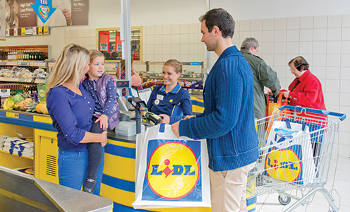
 As announced on Friday September 18th by Rhys Moore, Director of the Living Wage Foundation, "We are delighted by the move from Lidl to increase the pay of their staff to rates above the current UK and London voluntary Living Wage rates, and significantly higher than the national minimum wages". This makes the discount grocer the first supermarket chain in the UK to adopt the Living Wage commitment.
Today, a Lidl employee in England, Wales or Scotland earns a minimum of £7.30 per hour, and £8.03 in London. The salary increase will be effective as early as next month for 9,000 (out of 17,000) Lidl workers, from 1st October: an hour will pay at least £8.20 across the UK and £9.35 in the UK.
This will surely trigger a reaction from Lidl's competitors, which are already quite worried about the German discounter's progress. Especially since Lidl is also working on its image, the "low-cost" label being sometimes perceived as negative. Lidl is therefore looking for small to medium-sized locations to open in central London. Not just a few: the goal is close to 300 convenience stores. In the meantime, the company headquarters will move from Wimbledon to South West London, where a 220,000 sq ft new building will be built to house a staff of 750 people.
Photo: lidl.co.uk
News in the same category
It is no use looking for a bottle of wine in BiBoVino stores, as bottles have simply been replaced by Bag-in-Boxes (BiB) of 3 or 5 litres. However, the store makes a point of selecting quality wines.
Pret a Manger unveiled its new store in Cardiff in October, becoming the first company to open a shop as part of the city's new Central Square development.
Croft Carpets in Lincoln have celebrated their tenth anniversary with a move to new larger premises.
Mothercare has obtained agreement to its company voluntary arrangements (CVA), and the restructuring of its finances - at least for the time being.